





Did God B
For twenty years, one ordinary family in a quiet hill town lived next to the most sacred object in Israel — and nobody wrote a single miracle story about them.
That’s the strange, honest heart of the question people keep typing into Google: did God bless the house of Abinadab? The short answer is yes, but not in the loud, dramatic way most people expect. His house was chosen, trusted, and kept safe for two decades. That is a blessing, even though Scripture never explicitly says that God blessed Abinadab’s house the way it does another man just a few verses later.
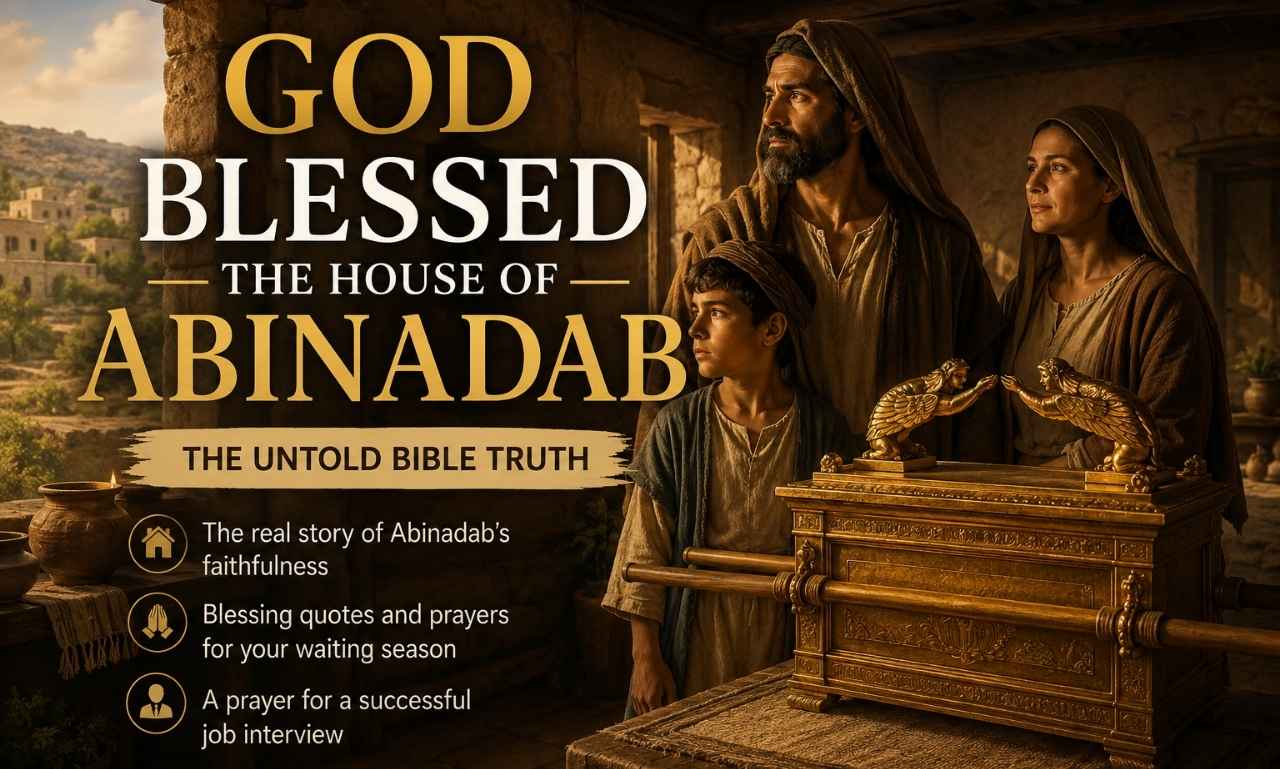
This article walks through what actually happened in the house of Abinadab, why the confusion with Obed-Edom exists, and — because so many readers come here searching for both — a full collection of original blessing quotes and prayers for seasons of waiting, including a prayer for a successful job interview. The story of how God Bless the House of Abinadab reminds us that faithfulness in the waiting is its own kind of blessing, and that’s really the heart of God Bless the House of Abinadab as a message for anyone in a season of uncertainty.
Who Was Abinadab in the Bible, and Why Did the Ark Come to His House?
Abinadab lived in Kiriath-jearim, a town on a hill west of Jerusalem. After the Philistines returned the Ark of the Covenant because it had brought them nothing but disaster, the men of Beth Shemesh didn’t want to keep it either. So the Ark of the Covenant was sent up to Abinadab’s house, and his son Eleazar was set apart to guard it (1 Samuel 7:1-2).
There’s no burning bush moment here. No angel visitation. Just a family agreeing to keep something holy safe, day after ordinary day, for twenty years of peaceful stewardship.
That detail matters. Most of us imagine blessing as a single dramatic event. Abinadab’s story says otherwise — sometimes blessing looks like quiet, unglamorous responsibility, carried faithfully for longer than anyone would choose.
Did God Actually Bless the House of Abinadab?
This is where most articles get sloppy, so let’s be precise.
Scripture doesn’t explicitly state that God blessed Abinadab’s household. The explicit blessing language appears later, in 2 Samuel 6, after King David finally moves the Ark toward Jerusalem. Uzzah, one of Abinadab’s sons, reaches out to steady the Ark on the cart and is struck down. David, afraid, leaves the Ark instead at the house of a man named Obed-Edom — and it’s Obed-Edom’s household that the text says God blessed (2 Samuel 6:11-12).
So why does “God blessed the house of Abinadab” show up in searches at all?
Because in the broader, everyday sense of the word, hosting the presence of God for two full decades without incident, raising a son set apart for sacred service, and being trusted with Israel’s holiest object is a blessing — even without the label. Abinadab’s house was chosen. It was kept. It was part of the story God was writing toward David’s throne and, eventually, toward Jesus. That’s favor, even when the text doesn’t spell it out in bold letters.
The tragedy of Uzzah later doesn’t undo the years of peaceful stewardship that came before it. It’s simply a reminder that closeness to something sacred requires reverence, not just proximity.
What Most People Get Wrong About Bless the House of Abinadab
A lot of pages online state, flatly, that “the Bible says God blessed the house of Abinadab.” That’s not accurate, and it’s worth correcting directly, because it changes how you read the rest of the story.
Here’s the actual pattern in the text:
- The Ark stayed in Abinadab’s house for about twenty years (1 Samuel 7:1-2). No blessing or curse is recorded during that time.
- When the Ark was finally moved, Uzzah — from Abinadab’s own household — was struck down for touching it (2 Samuel 6:6-7).
- The explicit, named blessing goes to Obed-Edom’s house a short time later (2 Samuel 6:11-12), after the Ark rested there for three months.
So the honest answer is: Abinadab’s house experienced twenty years of quiet, protected stewardship — which is its own kind of favor — but Scripture reserves the word “blessed” for Obed-Edom, not for Abinadab. Getting this right doesn’t weaken the story. If anything, it makes Abinadab’s faithfulness more remarkable, because it wasn’t rewarded with a headline.

House of Abinadab Blessing vs. Obed-Edom: What’s the Difference?
Readers searching “House of Abinadab blessing” are usually trying to understand this exact contrast. Here’s the clearest way to see it:
- Abinadab’s house faithfully cared for the Ark for two decades — no specific blessing or judgment is recorded during that period.
- Obed-Edom’s house held the Ark for only three months, and Scripture explicitly records prosperity flowing to his entire household.
- The difference comes down to timing, narrative purpose, and God’s plan — not to Abinadab’s worthiness.
If you’ve ever felt like you’re doing the faithful, unseen work while someone else gets the visible reward, this part of the Bible was written for you too. Abinadab’s obedience wasn’t wasted. It just wasn’t the part of the story Scripture chose to spotlight
.

Blessing Quotes Inspired by the House of Abinadab
These original lines reflect the quiet, faithful kind of blessing this story represents — the kind that doesn’t always come with fireworks.
- “Not every blessing announces itself. Some just stay, year after year, and call it home.”
- “God can trust you with something sacred long before He ever explains why.”
- “The house that holds what’s holy doesn’t always get the headline — but it gets the honor.”
- “Twenty quiet years of faithfulness can be worth more than one loud miracle.”
- “Faithfulness without applause is still faithfulness.”
- “Some blessings are measured in what never went wrong.”
- “Being chosen to guard something sacred is a blessing, even before it’s ever named one.”
- “God’s presence in your home is the blessing — the announcement is optional.”
- “You don’t need Scripture to say your name for God to have written your story.”
- “The reward for faithfulness isn’t always visible in your lifetime, but it’s never wasted.”
- “A quiet season of obedience is still a season of favor.”
- “What God trusts you with says more about His love than what He explains to you.”
- “There is honor in being the steady house, not just the celebrated one.”
- “Your unseen years are still counted.”
- “Some of the holiest work looks like nothing happening at all.”
Prayers and Blessings for Seasons of Waiting
Abinadab’s family waited two decades without a promise of what came next. If you’re in a similar season, these Bible-inspired prayers for patience and trust are for you.
- “Lord, let me be faithful in the waiting, even when I can’t see the reason for it.”
- “Father, teach me to trust You with what’s sacred in my life, even before You explain the plan.”
- God, give me patience to steward this season well, not just endure it, and through God Bless the House of Abinadab, remind me that faithful waiting is also a blessing.
- “Lord, I release the need to be noticed and ask instead to be faithful.”
- “Father, keep my heart soft during the delay, not bitter.”
- “God, let my quiet obedience today be the foundation for tomorrow’s breakthrough.”
- “Lord, remind me that You are working even when nothing visible is happening.”
- “Father, help me steward what You’ve entrusted to me with reverence, not carelessness.”
- “God, give me peace in the in-between.”
- “Lord, let my waiting season shape my character, not just my calendar.”
- “Father, I trust Your timing over my timeline.”
- “God, thank You for the years no one applauded — I know You saw them.”
Prayer for a Successful Job Interview During a Waiting Season
A waiting season isn’t only spiritual — it also appears in everyday moments like job interviews. Here’s the connection: Abinadab’s house had to steward something sacred before the outcome was ever clear. A job interview asks the same of you — faithful preparation before the result is known.

- “Lord, calm my nerves and let my preparation speak for itself. Just as God Bless the House of Abinadab reminds us of faithful waiting, help me trust You today.”
- “Father, give me clarity and confidence to answer honestly and well.”
- “God, let favor go before me into this interview.”
- “Lord, help me represent my true skill and character, not just my anxiety.”
- “Father, open the door that’s meant for me, and close the ones that aren’t.”
- “God, give the interviewer discernment to see my potential clearly.”
- “Lord, steady my voice and my thoughts in the moment I need them most.”
- “Father, whatever the outcome, let me walk in knowing I was faithful in the preparation.”
- “God Bless the House of Abinadab teaches that Your timing is always perfect. Let this opportunity align with the purpose You’ve placed in me.”
- “Lord, replace my fear of rejection with confidence rooted in You.”
- “Father, may this be the beginning of the provision I’ve been praying for.”
- “God, thank You in advance for the outcome, whichever way it turns. May God Bless the House of Abinadab remind me that faithful waiting and trusting in Your plan always have purpose. Amen.”
Faith Quotes About God’s Presence in Your Home
- “A home that welcomes God’s presence is never truly empty, even in silence.”
- “What you make room for in your life shows what you truly value.”
- “God Bless the House of Abinadab reminds us that presence changes a house before promotion ever does.”
- “You can’t rush what’s meant to dwell with you — you can only make space for it.”
- “The most sacred rooms are often the quietest ones.”
- “Hosting holiness requires reverence, not performance.”
- “God doesn’t need a stage to show up — He just needs an open door.”
- “Some seasons ask you to guard, not to announce.”
- “Sacred trust is still trust, even when no one’s watching.”
- “God Bless the House of Abinadab is a reminder that the presence you protect today becomes the legacy you leave tomorrow.”
What These Quotes and Blessings Mean
Every quote above circles back to one truth: blessing and visibility are not the same thing. Abinadab’s household teaches that being trusted with something sacred, holding steady through uncertainty, and staying faithful without recognition are all forms of favor — even when nobody writes it down as one.
Many readers connect with this because most of life happens in the Abinadab chapter, not the Obed-Edom one. Most of us are in the twenty quiet years, not the three celebrated months. These words give language to that in-between space — the waiting that still counts, even when it isn’t loud.
When to Use These Quotes and Prayers
- During a long season of waiting — a job search, a health journey, a delayed dream — use the waiting-season prayers as a daily anchor.
- Before an interview, exam, or major decision — use the job interview prayers to steady your mind beforehand.
- In devotionals or Bible study groups — the blessing quotes work well as discussion openers on faithfulness versus visibility.
- On social captions — short lines like “not every blessing announces itself” pair naturally with quiet, everyday photos.
- In sympathy or encouragement cards — for someone doing hard, unseen work, these quotes affirm that their effort matters.