




Table of Contents
- Introduction
- What Does “Count Your Blessings” Mean in Scripture?
- Psalm 103: The Anchor Passage
- Scripture About Naming Your Blessings
- Scripture About Gratitude in Hard Seasons
- Scripture About God’s Faithfulness and Provision
- Scripture About Thanksgiving as Worship
- Short Reflections on Counting Your Blessings
- A Prayer for a Grateful Heart
- Practical Ways to Count Your Blessings Daily
- What This Scripture Really Means
- When to Use These Verses
- Related Reading
- Conclusion
- FAQs
Introduction
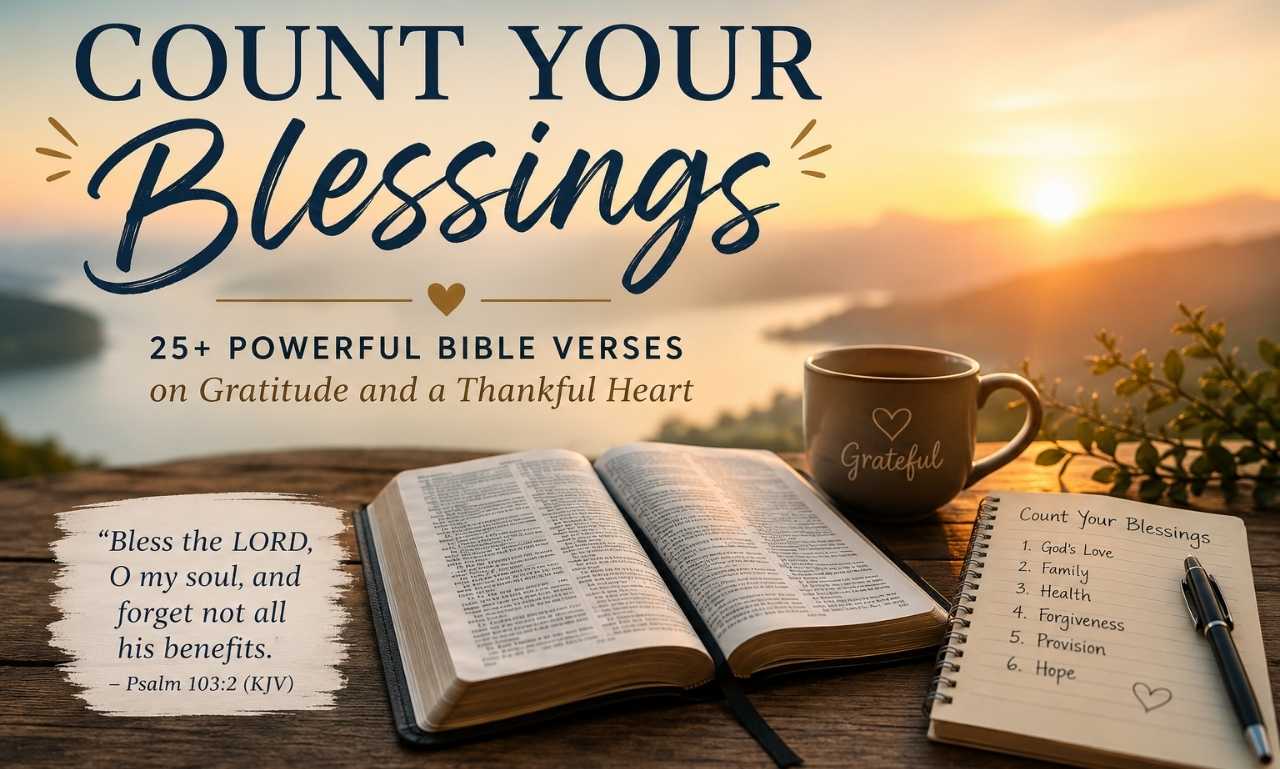
“Count your blessings” isn’t a phrase invented by a greeting card company—it’s rooted in scripture, in a command repeated across the Psalms to actively remember, name, and give thanks for what God has done. Count your blessings scripture points to something more specific than a vague sense of gratitude; it points to a practice.
Use the table of contents to jump to what fits, or read through the full collection below. Whether you’re looking for count your blessings scripture for personal devotion, Bible study, or daily encouragement, you’ll find meaningful verses to strengthen your faith and thankfulness.
This collection gathers more than 25 Bible verses about counting your blessings, organized around the themes Scripture itself returns to again and again—naming what God has done, staying grateful in hard seasons, trusting His provision, and treating thanksgiving as an act of worship. If you’re searching for count your blessings scripture, these carefully selected passages will help you develop a deeper understanding of biblical gratitude. Each verse is cited accurately (King James Version, noted throughout) so you can look up the full passage yourself.

What Does “Count Your Blessings” Mean in Scripture?
“Count your blessings” reflects a biblical pattern of actively remembering and naming what God has provided, rather than simply feeling grateful in a general sense. The clearest anchor for this idea is Psalm 103:1-2, which calls the reader to bless the Lord and specifically “forget not all his benefits”—a command to remember details, not just hold a vague feeling of thankfulness.
Psalm 103: The Anchor Passage
The chapter goes on to name those specifics directly—forgiveness, healing, redemption, provision, patience, mercy. It’s essentially a template for the entire practice of “counting” blessings: naming exact things, one at a time, rather than summarizing gratitude in a single sentence and moving on. Many devotionals built around this theme, including several referenced by other sources on this topic, treat Psalm 103 as the definitive starting point for exactly this reason. If you’re looking for a count your blessings scripture, Psalm 103 remains one of the clearest and most powerful passages to begin with.
Psalm 103 opens with David instructing his own soul to bless the Lord, and then, crucially, to forget none of His benefits. That’s worth sitting with for a moment: the psalm doesn’t just say “be thankful.” It says don’t let yourself forget the specifics. This count your blessings scripture reminds believers that gratitude begins by intentionally remembering God’s goodness.
Scripture About Naming Your Blessings

Verses that call for specifically remembering and naming what God has done, rather than offering only general thanks.
- Psalm 103:1-2—”Bless the LORD, O my soul… and forget not all his benefits.” The clearest biblical instruction behind the entire “count your blessings” concept.
- Psalm 68:19—Describes the Lord as one who “daily loadeth us with benefits,” framing blessing as a daily occurrence rather than a rare event.
- Deuteronomy 8:10—Instructs blessing the Lord specifically after eating and being satisfied, tying gratitude directly to provision received.
- Psalm 116:12—Asks, “What shall I render unto the LORD for all his benefits toward me?”—a reflective question meant to prompt naming those benefits.
- 1 Chronicles 16:8—Calls readers to “give thanks… make known his deeds among the people,” connecting personal gratitude to public declaration.
- Psalm 9:1—Commits to showing “forth all thy marvellous works,” a model of naming specific things rather than general praise.
- Psalm 40:5—Describes God’s thoughts toward us as “more than can be numbered,” directly connecting to the theme of counting—here, blessings that exceed counting altogether.
Scripture About Gratitude in Hard Seasons
Verses affirming that gratitude and difficulty can coexist—counting blessings isn’t reserved only for easy circumstances.
- Lamentations 3:22-23—Describes God’s compassions as new every morning, a promise offered from within genuine grief and loss.
- Habakkuk 3:17-18—Declares rejoicing in the Lord even if the fig tree fails to blossom, one of scripture’s clearest pictures of gratitude independent of circumstance.
- Job 1:21—”The LORD gave, and the LORD hath taken away; blessed be the name of the LORD,” spoken in the midst of devastating loss.
- Psalm 34:1—Commits to blessing the Lord “at all times,” not only when life feels easy.
- Romans 8:28—Assures that God works all things together for good, a foundation for gratitude that doesn’t require understanding the outcome yet.
- James 1:2-3—Instructs counting trials themselves as an occasion for joy, since they produce patience.
- 2 Corinthians 4:17-18—Frames present affliction as light and temporary compared to what it’s producing, reframing hardship within a longer view.
Scripture About God’s Faithfulness and Provision
Verses grounding gratitude in God’s character and consistent provision, rather than circumstances alone.
- James 1:17—Describes every good and perfect gift as coming down from the Father of lights, tying all blessing back to its source.
- Philippians 4:19—Promises that God will supply every need “according to his riches in glory.”
- Psalm 23:1—”The LORD is my shepherd; I shall not want,” a foundational statement of provision and care.
- Matthew 6:26—Points to birds, fed without sowing or reaping, as an argument for trusting God’s provision.
- Psalm 84:11—Promises that God will withhold “no good thing” from those who walk uprightly.
- Ephesians 1:3—Describes believers as blessed with “all spiritual blessings in heavenly places in Christ.”
- Malachi 3:10—Invites testing God’s provision directly, with a promise of blessing poured out “that there shall not be room enough to receive it.”
Scripture About Thanksgiving as Worship
Verses that treat gratitude not as a private feeling, but as an act of worship directed toward God.
- Psalm 100:4—Instructs entering God’s presence “with thanksgiving,” tying gratitude directly to worship.
- 1 Thessalonians 5:18—Instructs giving thanks “in every thing,” not only in favorable circumstances.
- Colossians 3:15—Ties peace and thankfulness together, instructing believers to “be ye thankful.”
- Philippians 4:6—Pairs prayer and supplication “with thanksgiving” as the alternative to anxiety.
- Psalm 92:1—Declares it “a good thing to give thanks unto the LORD,” framing gratitude as inherently good, not simply polite.
- Hebrews 13:15—Describes praise as a continual “sacrifice,” offered through lips that give thanks to His name.
- Psalm 107:1—Opens with a direct call to give thanks “for he is good,” a phrase repeated throughout the Psalms as a foundation for gratitude.

Short Reflections on Counting Your Blessings
Original lines inspired by this theme—not scripture themselves, but reflections meant to sit alongside it.
- A blessing uncounted is a blessing easily forgotten. Gratitude gets stronger the more specific it gets. Every count your blessings scripture reminds us that gratitude grows when we intentionally remember God’s goodness. Naming one blessing tends to surface three more you’d forgotten. Counting blessings isn’t about ignoring what’s hard—it’s about refusing to let the hard have the whole story. Some blessings only become visible once you go looking for them. Reflecting on a count your blessings scripture each day helps turn thankfulness into a lifelong habit of faith. A grateful memory takes practice, the same way any other memory does.
A Prayer for a Grateful Heart
Lord, teach me to remember, not just to feel thankful for a moment and move on. Help me name what You’ve done specifically, the way Your Word calls me to through every Count Your Blessings Scripture. Give me a heart that counts blessings even in hard seasons, trusting that Your faithfulness hasn’t changed just because my circumstances have. Amen.
Practical Ways to Count Your Blessings Daily
Count Your Blessings Scripture A short list for turning this scripture into an actual habit:
- Keep a written list. Add two or three specific blessings daily, not general categories.
- Read Psalm 103 regularly. Let it model what specific, named gratitude actually sounds like.
- Say it out loud. Naming a blessing verbally, even alone, tends to make it feel more real than just thinking it.
- Revisit hard seasons later. Looking back at a difficult year often reveals blessings that weren’t visible while you were in it.
- Pair gratitude with prayer. Philippians 4:6 ties the two together directly—let thanksgiving be part of your prayer, not separate from it.
What This Scripture Really Means
Count your blessings scripture resonates because it turns a vague feeling into a concrete practice. A few themes repeat across this collection:
- Specificity—naming exact things, the way Psalm 103 models, rather than offering vague thanks.
- Consistency—gratitude “at all times” (Psalm 34:1), not only when circumstances are easy.
- Worship—thanksgiving treated as an act directed toward God, not just a private feeling.
- Perspective—remembering blessings as a way of holding onto hope during hard seasons.
A verse like Habakkuk 3:17-18 outlasts a generic gratitude quote because it doesn’t wait for good circumstances before choosing thankfulness.
When to Use These Verses
- Personal devotion or Bible study—the categorized verse lists work well for reflection or memorization
- Journaling—pair a verse with your own daily gratitude list
- Teaching or small group study—Psalm 103 works especially well as an anchor passage for a lesson on gratitude
- Hard seasons—the verses on gratitude amid difficulty offer perspective without minimizing pain
- Daily prayer—the prayer for a grateful heart above works well as a short morning practice
Conclusion
Count your blessings scripture isn’t asking for a passing feeling of thankfulness—it’s calling for the discipline of actually remembering, the way Psalm 103 models from its very first line. Whether you’re studying this theme for a devotional, journaling through a hard season, or simply trying to build a more consistent gratitude practice, let these verses be something you return to, not just something you read once.