





Introduction
Best time to pary at night
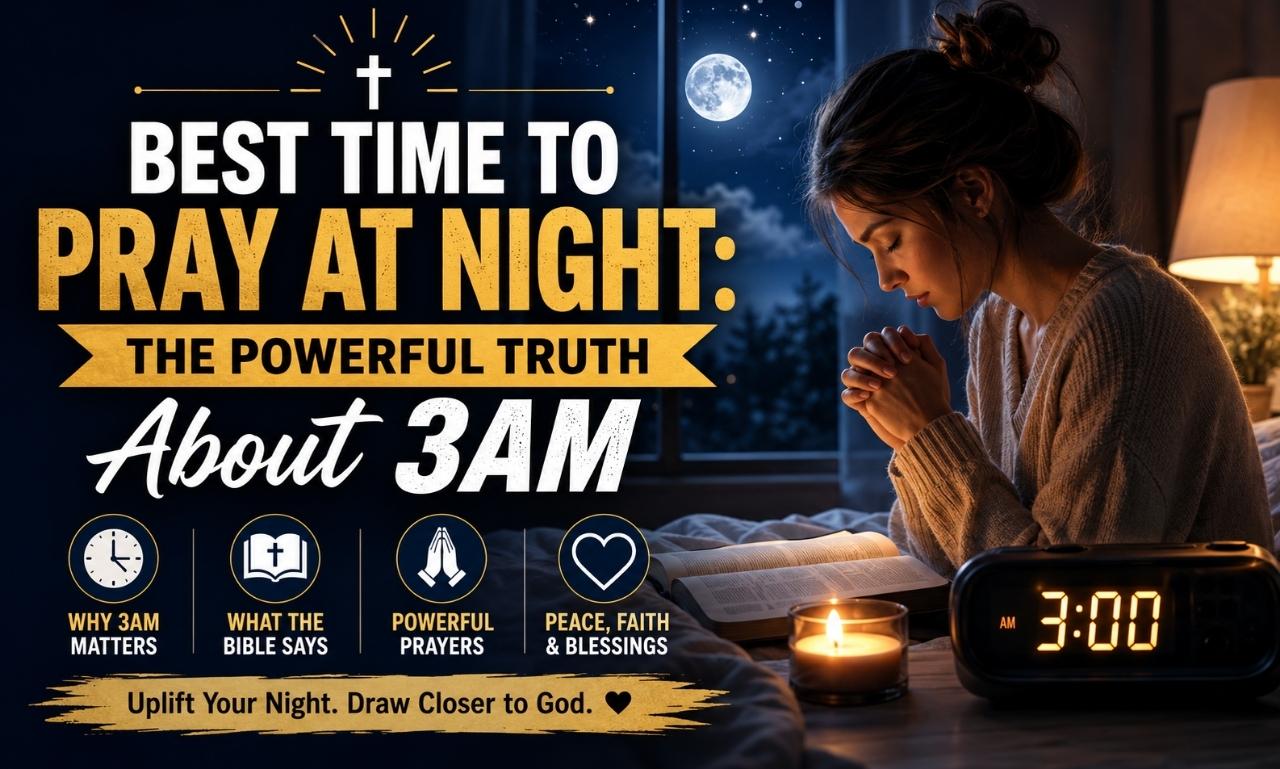
If you’ve jolted awake at 3am more than a handful of times, you’ve probably wondered whether it means something. A quick search turns up plenty of bold claims — that 3am is somehow the most spiritually potent hour to pray, that it’s tied to unseen activity, that it deserves special treatment on your prayer schedule. Some of that has real roots in Christian history. A lot of it is just repetition that nobody’s bothered to check.Best Time to Pray at Night
This guide looks at why “praying at 3am” has become such a popular search topic, traces where the idea actually comes from, examines what the Bible says about the timing of prayer more broadly (including the third watch), and separates genuine tradition from more recent invention. Along the way, you’ll find a straightforward prayer outline and a collection of brief prayers suited to whatever hour finds you awake.
Is 3AM the Best Time to Pray?
Scripture never says so. There isn’t a single passage that elevates 3am above any other hour. Even so, many believers are drawn to it — it’s undisturbed, it carries symbolic weight for some, and interruptions are rare. What the Bible does affirm is that God receives honest prayer no matter what the clock reads.
Why Do Some Christians Believe 3AM Is the Best Time to Pray?
The belief isn’t baseless — it comes from three main sources, though none of them amount to a scriptural mandate.
Symbolism. The Gospels place Jesus’s death near the ninth hour, around 3pm. Some Christian teaching treats 3am as the exact clock-opposite of that hour and presents it as a natural time for intercession or spiritual resistance.
Stillness. There are no notifications, no demands, nothing pulling for attention. That kind of undisturbed quiet is rare during waking hours, which makes it a natural fit for concentrated prayer.
History. Christians have held nighttime vigils for centuries, particularly in monastic settings, where prayer was structured into “watches” spanning the entire night. Much of today’s 3am teaching draws — often without saying so — on that older practice.
Notice that all three rest on symbolism, personal experience, and inherited custom, not on scripture directly naming 3am. That’s an important distinction: it makes 3am prayer a choice rather than a requirement, which is a far more sustainable way to approach it.
What Happens Spiritually at 3AM?
This is one of the most common questions on the topic, and it deserves a measured answer rather than a dramatic one.
Some believers interpret an unplanned 3am waking as God prompting them to intercede for someone or something — a conviction shaped by personal experience, not an explicit biblical instruction. For others, the hour is simply quiet, offering a natural space for reflection that happens to fall there.
What scripture does not teach is that something supernatural is guaranteed to occur at 3am, every night, for everyone. No verse promises spiritual activity tied to that specific hour, and teaching that implies otherwise tends to generate fear instead of genuine faith. If 3am starts to feel more like dread than peace, that shift is worth examining — a spiritual practice that consistently produces anxiety is worth reconsidering, whatever hour it happens to fall on.
What the Bible Actually Says About Prayer Timing
Scripture references prayer at many different hours, and no single one is marked as superior. Consider these examples:
- Daniel maintained a set pattern of praying three times each day, rather than tying himself to one hour (Daniel 6:10).
- The Psalms mention getting up to pray during the night, and separately reference prayer offered in the morning, at midday, and in the evening (Psalm 119:62; Psalm 55:17).
- Jesus prayed at multiple points across the day — before sunrise, in solitude, and through an entire night before he chose his twelve disciples (Mark 1:35; Luke 6:12).
- Paul’s instruction to pray without ceasing moves away from any single required hour entirely, pointing instead to an ongoing relationship with God rather than a scheduled window (1 Thessalonians 5:17).
Taken together, scripture presents prayer as woven through day and night alike, not clustered into one “power hour.” Framing 3am as uniquely necessary or superior reads more into the text than is actually there.
What Is the Third Watch in the Bible?
“Third watch” comes up frequently in discussions of nighttime prayer, so it’s worth defining precisely rather than loosely.
In antiquity, nights were split into watches — shifts originally used for guarding cities and camps. Earlier Jewish tradition sometimes divided the night into three parts, as suggested by Judges 7:19’s mention of “the middle watch.” By the New Testament era, Roman influence had shifted this to four segments of about three hours each: roughly 6–9pm, 9pm–midnight, midnight–3am, and 3am–6am.
This detail matters because of a well-known passage: the story of Jesus walking on water toward his disciples is set in the fourth watch — somewhere around 3am to 6am, not the third (Matthew 14:25; Mark 6:48). It’s a small but meaningful distinction, since modern teaching sometimes blurs “third watch” and “3am” into the same thing. The instinct behind that teaching isn’t wrong — this passage does describe a pivotal, faith-testing moment for the disciples during the early morning hours. It just doesn’t establish that 3am specifically carries more spiritual significance than other hours. It’s one meaningful moment, in one passage, somewhere within that broader window.
Jesus’s Example of Nighttime Prayer
Jesus’s prayer life covers more ground than any single verse can convey, so it helps to look at several moments together.
Gethsemane. On the night before his crucifixion, Jesus prays alone in a garden, returning repeatedly to find his disciples asleep each time (Matthew 26:36-46). It’s arguably scripture’s rawest depiction of nighttime prayer — anguished rather than calm or ceremonial.
Before major decisions. Ahead of choosing his twelve disciples, Jesus spends an entire night in prayer — a deliberate, extended session tied to a critical choice, not a routine (Luke 6:12).
Apart from the crowds. Several Gospel passages show Jesus withdrawing to pray alone, often after long periods of ministry, suggesting the solitude itself mattered as much as any particular hour (Luke 5:16).
Before daybreak. One account has Jesus rising well before sunrise to pray in a solitary place, ahead of the day’s demands (Mark 1:35).
Altogether, Jesus’s prayer habits span multiple hours and multiple purposes — grief, decision-making, solitude, preparation — rather than settling into one fixed time-based pattern.
Old Testament Examples of Night Prayer
Jesus isn’t the only biblical figure worth looking at here. Several Old Testament passages describe people seeking God at night.
- David writes about remembering God during the night and specifically describes getting up at midnight to give thanks (Psalm 63:6; Psalm 119:62).
- Samuel, still young and serving in the temple, hears God call his name while lying down at night — a passage often cited in discussions about God speaking during quiet nighttime hours (1 Samuel 3:1-10).
- Elijah, exhausted and afraid, meets God not in dramatic wind or fire but in a quiet, gentle whisper — a passage often used to illustrate that stillness, day or night, is frequently where God is heard most clearly (1 Kings 19:11-12).
- Daniel kept a consistent three-times-daily prayer rhythm even when it endangered his life, showing that consistency mattered more than any particular hour (Daniel 6:10).
- Nehemiah offers a quick, urgent prayer in the middle of a tense moment while standing before the king — evidence that scripture also honors brief, unplanned prayer whenever a need arises, not only prayer reserved for nighttime (Nehemiah 2:4).
Across all these examples, the common denominator isn’t a specific clock time — it’s sincerity, urgency, and a readiness to turn to God whenever the moment calls for it.
The “Devil’s Hour” Claim, Addressed Honestly
3am is frequently paired with phrases like “devil’s hour” or “witching hour” — the idea that it marks a window of heightened spiritual danger or demonic presence. It’s worth saying plainly: this idea has no scriptural basis. It’s folklore, popularized largely by horror films and internet content, not Christian doctrine.
That doesn’t discount the symbolic connection some believers draw between 3am and the hour of the crucifixion — many find genuine meaning in that link. But “devil’s hour” specifically belongs to modern urban legend rather than established teaching, and treating it as literal fact tends to create anxiety rather than any real spiritual understanding.
The Science Behind Waking at 3AM
It’s just as important to be clear-eyed here: waking around 3am is extremely common, and there’s a simple physiological explanation with nothing supernatural about it.
Your circadian rhythm. The body follows an internal clock that regulates temperature, alertness, and hormone release across roughly a 24-hour cycle. Sleep itself moves through distinct stages, and as the night progresses, shifting temperature and hormone levels make certain windows naturally easier to wake from.
Cortisol. In the hours leading up to your normal wake time, cortisol production begins climbing to help prepare your body for the day. Under stress, that rise can begin earlier and more sharply, often triggering a sudden wake-up — frequently right around 3am.
Lighter sleep phases. The early morning hours tend to include more REM sleep, the lighter, dream-heavy stage of the cycle. Waking briefly out of REM is far more common than surfacing from deep, slow-wave sleep earlier in the night.
Nervous system stress. Elevated stress hormones and an overactive nervous system are strongly associated with frequent nighttime waking, especially waking accompanied by racing thoughts. Sleep researchers see this pattern regularly, and it has no supernatural cause — even though it’s often exactly the moment people start searching for a spiritual explanation.
None of this rules out praying during that window if you’re up. It simply means the waking itself is ordinary biology, not evidence that something is happening purely because the clock says 3:00.
Benefits of Praying at Night
Regardless of how you feel about the spiritual significance of 3am specifically, there are solid, well-documented reasons to pray at night generally.
Fewer distractions. Phones fall silent, the household settles, and there’s usually nowhere else you need to be. That absence of competing demands makes it easier to stay focused.
Deeper focus. With the day’s mental noise no longer running in the background, nighttime prayer often reaches a level of depth that’s harder to reach during a busy daylight schedule.
Peace before sleep. Ending the day — or an unplanned wake-up — with prayer rather than scrolling or spiraling tends to calm the mind more effectively, making it easier to fall or stay asleep.
Spiritual discipline. Choosing to pray at an inconvenient hour, not just a convenient one, builds a kind of consistency that strengthens faith over time, whether or not that particular hour has any inherent significance.
Gratitude. Nighttime naturally invites looking back over the day, making it a fitting moment to name specific things you’re thankful for before they slip your mind.
Emotional processing. Slower, unhurried prayer opens space to work through grief, worry, or unresolved feelings that a hectic day tends to crowd out — many people find their most honest prayers happen at night, simply because there’s nowhere left to hide from what’s really on their mind.
Sustainable habit-building. For some, an unpredictable schedule makes the middle of the night or early morning the only reliably quiet stretch available — which, practically speaking, makes it the most realistic time to build a lasting prayer habit, whether or not it happens to be 3am.
Common Mistakes People Make About 3AM Prayer
A few patterns worth flagging directly, since they show up repeatedly in this space:
- Believing God listens more closely at 3am. Scripture offers no support for this, and treating one hour as spiritually elevated can quietly make every other prayer feel less meaningful.
- Turning the hour into something to fear. Taken literally, “devil’s hour” framing can make 3am feel threatening rather than peaceful — the opposite of what prayer is meant to offer.
- Giving up sleep to chase a “holy” schedule. Deliberately disrupting healthy rest to force a specific prayer time can cause real harm, especially for anyone already struggling with sleep or anxiety.
- Treating prayer as a formula rather than a relationship. Approaching 3am prayer as though the right hour guarantees a particular result misses the point — prayer is about connection, not technique.
What to Do If You Wake Up at 3AM
If you find yourself awake, here are some grounded options — regardless of what you believe about the hour itself:
- Keep it brief. No elaborate structure is necessary; a short, quiet prayer, spoken or simply thought, is enough.
- Put the phone down. Screen light makes it harder to fall back asleep and can turn a quiet moment into aimless scrolling.
- Name what’s actually bothering you. If something specific woke you, saying it out loud in prayer — rather than letting it loop silently — tends to bring more peace than trying to ignore it.
- Allow yourself to drift back off. A short prayer doesn’t have to become a full vigil unless that’s genuinely what you want.
- Talk to a doctor if it’s frequent. Regular middle-of-the-night waking, especially paired with anxiety, is worth checking as a possible sleep issue.
A Simple 3AM Prayer Routine
If you’d rather have some structure than pray freeform, this quick ten-minute outline works well in the middle of the night:
- 1 minute — Gratitude. Name one or two specific things you’re thankful for, no matter how small.
- 2 minutes — Worship. Focus on who God is, apart from anything you currently need from Him.
- 3 minutes — Confession. Bring whatever’s weighing on you into the open honestly, without rushing.
- 3 minutes — Intercession. Pray by name for the people on your mind — family, friends, situations you’re carrying.
- 2 minutes — Scripture. Recall or read a short passage, even just sitting quietly with a single verse.
- 1 minute — Silence. Rest without speaking, simply present, before easing back toward sleep.
This isn’t a rigid formula — just a starting point anyone can adjust to whatever time or energy they actually have in the moment.
Short Prayers for the Middle of the Night
Simple, easy-to-say prayers for whenever you find yourself awake — no elaborate structure required.
- Lord, I’m awake. Whatever the reason, I trust You’re near. Amen.
- Father, quiet my mind and let me rest again soon. Amen.
- Lord, thank You for this unexpected moment. Use it if You want to. Amen.
- Father, watch over the people on my heart right now. Amen.
- Lord, I don’t know why I’m awake, but I know You’re not surprised by it. Amen.
- Father, still my thoughts and give me peace enough to sleep. Amen.
- Lord, if there’s something You want me to bring to You, I’m listening. Amen.
- Father, thank You for another day, even before it’s fully begun. Amen.
- Lord, cover my home and my family while the world is quiet. Amen.
- Father, I release what I can’t control and trust You with the rest. Amen.
- Lord, meet me here in the stillness, however ordinary this moment is. Amen.
- Father, calm my body and quiet my mind so rest can come. Amen.
- Lord, thank You for hearing me at 3am just as clearly as at noon. Amen.
- Father, whatever tomorrow holds, I trust You’re already there. Amen.
- Lord, let this brief waking be peaceful, not anxious. Amen.
Bible Verses About Praying at Night
A handful of scripture references (King James Version), summarized in plain language rather than quoted directly, so you get the meaning without repeating long blocks of text. Look up each passage directly for its full context.
- Psalm 119:62 — Describes rising in the middle of the night specifically to give thanks, framing prayer as a deliberate choice rather than something midnight requires.
- Psalm 63:6 — Depicts the writer remembering God during the quiet hours of the night, a simple image of after-dark reflection.
- Mark 1:35 — Shows Jesus rising well before sunrise to pray alone in a quiet place, an early hour chosen deliberately for prayer.
- Luke 6:12 — Describes Jesus spending an entire night in prayer before selecting his twelve disciples, an example of extended, intentional nighttime prayer tied to a major decision.
- Matthew 14:25 — Places Jesus’s walk across the water toward his disciples in the fourth watch of the night, roughly 3am to 6am.
- 1 Thessalonians 5:17 — Instructs believers to pray continually, shifting the emphasis toward an ongoing posture rather than one scheduled hour.
- Psalm 42:8 — Links God’s steady love shown during the day with a song offered at night, tying daytime and nighttime prayer into a single relationship.
Best Time to Pray: A Quick Comparison
| Prayer Time | Common Benefit |
| Morning | Sets focus and intention before the day begins |
| Noon | Builds consistency in the middle of a busy day |
| Evening | Encourages reflection on the day that’s ending |
| Midnight | Offers quiet, deliberate stillness |
| 3am | Silence, personal devotion, freedom from distraction |
No row here is objectively “correct” — each simply reflects a different, equally valid reason someone might choose that time.
Best Time to Pray According to the Bible
- Morning ✓ — reflected in Jesus praying before sunrise and in Psalm 5:3
- Noon ✓ — part of Daniel’s three-times-daily rhythm (Daniel 6:10)
- Evening ✓ — referenced alongside morning and midday prayer in Psalm 55:17
- Midnight ✓ — reflected in Psalm 119:62 and in Paul and Silas praying at midnight (Acts 16:25)
- Anytime ✓ — the broader instruction to pray continually, found in 1 Thessalonians 5:17
So What Actually Is the Best Time to Pray?

Based on what scripture actually shows, the most honest answer is: whatever time you’ll genuinely pray with sincerity and consistency. Daniel kept a fixed daily rhythm. Jesus prayed before dawn and through entire nights, depending on the situation. Paul pointed toward continuous, ongoing prayer rather than a single scheduled appointment.
If 3am happens to be when you’re naturally awake, and it becomes a genuinely meaningful time of connection, that has real value — not because the hour carries any magic, but because you showed up. The same holds true for an early prayer before work, a few minutes during lunch, or a prayer said right before sleep. Consistency and sincerity matter far more than the number on the clock.
When to Use These Night Prayers
- Waking unexpectedly in the middle of the night, whether or not you attach spiritual meaning to the timing
- Struggling to fall back asleep and wanting to redirect racing thoughts
- Maintaining a regular nighttime prayer practice, if you’ve chosen to pray during quiet, undistracted hours
- A season of worry or stress, when short prayers help settle an anxious mind before sleep
- Praying over specific people or situations that come to mind during a quiet wakeful moment
Conclusion
There’s nothing wrong with finding meaning in 3am — many sincere believers do, and the symbolic tie to the crucifixion hour reflects a real, long-standing tradition worth respecting. But it’s worth holding that belief honestly: scripture doesn’t single out 3am, or any hour, as the objectively best time to pray. What matters more is showing up whenever you’re genuinely able to pray with sincerity — whether that’s 3am, 6am, or ten quiet minutes carved out of a lunch break.
If this article brought you some encouragement, consider sharing one of these prayers with someone who might be awake tonight and in need of God’s peace.
FAQs About Praying at 3AM
1. Why is 3am considered the best time to pray?
3am is often linked to prayer because some Christian traditions treat it as the symbolic mirror image of the hour Jesus died, roughly 3pm. This connection is rooted in tradition and symbolism, not a direct scriptural command naming 3am as required or superior.
2. Is there a biblical basis for praying at 3am?
Scripture doesn’t call out 3am as a designated prayer hour. It describes prayer at various points — midnight, before sunrise, throughout the night — without presenting any single hour, including 3am, as uniquely mandated or more effective.
3. What does it mean when you wake up at 3am?
Most often, it simply means your sleep cycle briefly surfaced into a lighter stage — a normal part of how sleep works, closely tied to your internal clock and rising cortisol levels. Some people of faith choose to read an unexpected wake-up as a prompt to pray, which is a matter of personal conviction rather than something scripture explicitly states.
4. Is 3am the “devil’s hour”?
This idea has no grounding in the Bible. It’s popular folklore, spread mostly through film and internet content rather than Christian teaching. Some believers do draw a symbolic connection between 3am and the crucifixion hour, but that’s a separate idea from the “devil’s hour” concept.
5. What is the best time to pray according to the Bible?
Scripture doesn’t name one best time. It shows prayer happening in the morning, at midday, in the evening, at midnight, and continually — suggesting that consistency and sincerity matter more than any particular hour.
6. What should I pray if I wake up at 3am?
A short, honest prayer is enough — thanking God for the moment, asking for peace or rest, or simply bringing whatever’s on your mind to Him. There’s no required format; brevity and sincerity matter far more than length.
7. Is waking up at 3am spiritual or just poor sleep?
It can genuinely be either, and the two aren’t mutually exclusive. Occasional waking is a normal part of the sleep cycle, tied to lighter REM stages and rising cortisol. If it happens often and causes real distress, it’s worth checking with a doctor as a possible sleep issue — while still choosing to pray during those wakeful moments if that feels meaningful.
8. What Bible verses talk about praying at night?
Passages describing midnight prayer, quiet nighttime reflection, and Jesus praying through an entire night before choosing his disciples are among the clearest scriptural examples of nighttime prayer (Psalm 119:62; Psalm 63:6; Luke 6:12).
9. Is midnight or 3am more significant for prayer?
Neither carries greater scriptural weight than the other. Midnight prayer has a longer documented history, particularly within monastic tradition, while the significance attached to 3am is more rooted in modern symbolic teaching tied to the crucifixion hour.
10. Does God hear prayers better at certain times?
Scripture gives no indication that God hears prayer more clearly during one hour than another. It consistently presents God as attentive to prayer at any time, day or night, rather than more responsive during a particular window.
11. What is the third watch prayer, and how is it different from 3am?
“Third watch” refers to the ancient Roman division of night into four three-hour segments; the third watch covered roughly midnight to 3am, while the fourth watch — the one tied to the account of Jesus walking on water — covered roughly 3am to 6am. Some modern teaching uses “third watch” loosely to describe early morning prayer in general, but the two terms technically point to slightly different windows.
12. Should I set an alarm to pray at 3am?
That’s entirely a personal choice, not a biblical requirement. Some find genuine value in deliberately waking to pray, echoing older monastic traditions; others find it more sustainable to build a consistent prayer habit at a time that doesn’t interfere with sleep. Neither path carries more spiritual legitimacy than the other.
13. Can I pray if I don’t wake up at 3am at all?
Absolutely. Nothing in scripture ties prayer to waking during the night. A steady prayer habit at any hour — morning, midday, before bed — carries just as much meaning as nighttime prayer, and tends to be far more sustainable for most people.
Read more about us.
Apostolic Blessing of the Throat Prayer: History, Meaning & How to Pray It